Teleprompter for YouTube, Shorts and Reels
A script keeps your video tight. A teleprompter lets you deliver it without memorizing every line or cutting after each sentence. Here's how creators make scripted videos that still sound like a conversation.
Why script a YouTube video at all?
Unscripted videos ramble. Viewers decide in the first few seconds whether to stay, and every "so, um, what I wanted to say" is a reason to leave. A script lets you cut the filler before you press record instead of in the edit. A teleprompter solves the next problem: reading the script without your eyes flicking to a laptop off to the side.
The goal isn't to sound read. It's to say exactly what you planned in the voice you'd use with a friend. That comes down to three things: how you write, where the text sits, and how fast it moves.
1. Write for the ear, not the page
- Short sentences. If you need a breath in the middle, split it.
- Contractions and everyday words. "You'll", not "you will"; "use", not "utilise".
- Bullet-style sections for B-roll. When you'll cut away to footage, the script can be looser; you only need the narration.
- Front-load the hook. Your first two lines decide whether people watch. Write them last, once you know the payoff.
More detail, plus a template, in how to write a teleprompter script.
2. Put the words at the lens
Viewers notice when your eyes track across a screen. The fix is distance: keep the text close to the camera and in a narrow column, so your eyes move as little as possible.
- Webcam or laptop: open the online teleprompter in a small window directly under the webcam and set the text width to 40–50%.
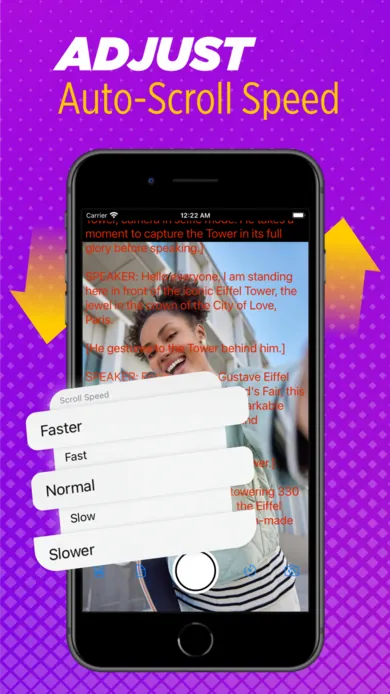
- Phone: the Tuzu app shows the text over the selfie camera, so it's already in the right place. Read the lines nearest the top of the screen.
- Camera with glass: a beam-splitter rig puts the text directly in front of the lens. Use the mirror teleprompter on the tablet underneath.
Sit further back if you can. At 1.5 metres the eye movement needed to read a line is far smaller than at 50 cm.
3. Match the speed to your voice
If the text sets the pace, you'll sound like you're chasing it. Talking-head YouTube videos usually land around 140–170 words per minute. Do one practice read, then adjust until the reading line stays a beat ahead of your voice. See choosing scroll speed.
Shorts, Reels and TikTok
Vertical short-form video has its own constraints:
- Word budget. 30 seconds is roughly 70–85 words; 60 seconds is 140–160. Check yours with the speech time calculator and leave a buffer before any hard limit.
- Pace. Short-form tends to be brisk. Try 160–180 wpm, but keep the hook slower and clearer.
- Selfie framing. On a phone, the teleprompter text covers part of the preview. Frame yourself first, then add the text.
- Native teleprompters. Some editing and social apps now include a basic teleprompter for their own camera. A dedicated tool gives you more control over pace and text, and keeps your script outside any one platform.
A simple recording routine
- Read the script out loud once, away from the camera, and fix anything you stumble over.
- Mark breaths and emphasis: a blank line for a pause, CAPS for a stressed word.
- Record in sections, one paragraph or idea per take. It's easier to restart and easier to edit.
- Leave a two-second gap of silence before each section so cuts are clean.
- Watch the first take with the sound off. If your eyes are moving, narrow the text or move it closer to the lens.
Frequently asked questions
Do YouTubers use teleprompters?
Many scripted channels do, especially explainers, reviews, news and educational videos. It's a common way to deliver a tight script without memorizing it. Some use hardware glass rigs; many use a phone app or a browser teleprompter next to the camera.
How do I read a script without looking like I'm reading?
Keep the text close to the lens and in a narrow column, set the speed slightly behind your natural pace, and rehearse the script out loud once so the words are familiar. Our guide to reading a script on camera covers it step by step.
How many words is a 60-second Short?
About 140–160 words at a typical pace. If the platform cuts off at 60 seconds, aim for 120–140 to leave space for the first breath and a clean ending.
Can I record directly with the online teleprompter?
Yes. In the teleprompter, switch on the camera to see yourself behind the text and press record. The file saves to your device with no watermark, ready to drop into your editor.
Film on your phone?
Tuzu scrolls your script over the iPhone or iPad selfie camera while you record. Free download; one-minute videos are free.